AI Workflow · Ops Tooling · Human-in-the-loop · Workflow Design
Semi-automated Job Decision Workflow
半自动化 JD 决策工作流
2026

01 | 项目概述 Project Summary
一个围绕高频岗位投递决策这一真实痛点搭建的半自动化工作流。通过 Claude API 实时解析岗位 JD,匹配三版差异化简历与招呼语版本,输出结构化「投递决策卡」。
A semi-automated workflow built around a real pain point — the repetitive, high-volume judgment of triaging job postings. It uses the Claude API to parse job descriptions in real time, match against three differentiated resume and outreach versions, and output a structured "application decision card."
工作流核心定位:不替代人做判断,而是把"识别同名异向、版本匹配、风险归类"这类结构化但重复的判断成本降到趋近于零,让使用者把精力留在真正需要权衡的取舍上。
The core positioning is not to replace human judgment, but to drive the cost of structured-yet-repetitive decisions toward zero — letting the user keep focus on the trade-offs that actually require thinking.
两天内累计判断 108 个岗位,平均决策时间从 5 分钟 / 个降至 30 秒 / 个。
Across two days, 108 positions were processed; per-decision time dropped from roughly 5 minutes to 30 seconds.
02 | 为什么做这个 Why I Built This
处理大量岗位投递时,反复撞到三个交叠的真问题。
Three overlapping problems that surface when triaging job postings at volume.
同名异向 / Same Title, Different Reality
同样叫"AI 产品运营"的岗位,实际工作内容差异极大——有的偏投流,有的偏内容,有的偏 prompt 工程。光看 title 无法判断方向。
Jobs called "AI Product Operations" can mean ad performance, content ops, or prompt engineering. Title alone cannot tell.
重复决策成本高 / High Repetitive Decision Cost
每个岗位都要经历"读 JD → 判断方向 → 选简历版本 → 写招呼语 → 决定投不投"。一晚最多深度判断 10 个岗位,效率瓶颈在判断而非投递。
Each posting required reading JD → deciding direction → picking resume version → writing greeting → final go/no-go. Throughput was capped at the decision step, not the application step.
反馈周期长、信号稀疏 / Long Feedback Loop, Sparse Signal
投递的反馈周期长,回应往往滞后、数量也少——这一点不是工具能改变的。
Feedback on applications is slow and sparse — and that is not something tooling can change.
所以这套工作流不以"提高回复率"为目标,而是在反馈稀疏的阶段维持一个结构化、可重复的判断节奏,让瓶颈停在"判断质量",而不是"体力"。
So this workflow does not aim to "increase reply rate." It keeps the judgment running at a structured, repeatable pace while feedback is sparse — so the bottleneck stays on the quality of the decision, not on stamina.
03 | 工作流怎么设计 Workflow Design
decisions_log.csv 台账供后续统计。 / The full path a single posting takes, from raw JD text to archive. The model handles parsing and the five-dimension judgment, producing a decision card with ten fixed fields; whether to apply is decided by the person. Of the two archives, Markdown is for re-reading and decisions_log.csv feeds later statistics.设计原则 / Design Principles
Workflow Design —— 把重复人工判断转成可复用的结构化输出,每张决策卡 10 个字段固定,便于横向比对。
Convert repetitive judgment into reusable structured output, with 10 fixed fields per card to allow horizontal comparison.
Human-in-the-loop —— 工具只判断不投递,"立即沟通 / 投递 / 拒绝"由使用者手动完成。这一点是有意为之,07 节展开。
Tool decides, human applies. "Initiate chat / submit / decline" remain manual actions — a deliberate boundary, expanded in section 07.
降级容错 / Graceful Degradation —— 如果 JD 提取失败或方向无法识别,决策卡会显式输出"信息不足"或"无可用简历版本",不强行做判断。
When JD extraction fails or direction cannot be inferred, the card explicitly outputs "insufficient information" rather than forcing a decision.
04 | 技术路径选择 Path Selection
在到达当前命令行半自动版本之前,先后实践 / 评估过三条技术路径,每条因为不同原因调整方向。完整记录构成了项目的 Failure Postmortem 档案——这是 ops 工作里"决策可追溯"的核心实践。
Before arriving at the current CLI semi-automatic version, three technical paths were explored and adjusted. The full record forms the project's Failure Postmortem archive — a core practice of "traceable decision-making" in ops work.
路径 1 | BOSS CLI 接口自动化 / API Automation
尝试通过开源 boss-cli 工具搭建"搜索 → 详情 → 筛选 → 招呼"全自动链路,包裹一层 safe wrapper 严格阻止越权操作(cookie 读取 / 自动登录 / 自动投递)。
Attempted full automation via open-source boss-cli, wrapped in a safe layer that strictly blocked over-privileged actions (no cookie reads, no auto-login, no auto-apply).
结果:单次只读 search 跑通过;详情接口受 session 时效限制;批量 search 触发平台风控信号("风控" marker)。Wrapper 按既定规则立即 STOP,避免了账号风险。
Outcome: single-shot read-only search worked; detail endpoint hit session-expiry constraints; batch search triggered the platform's risk-control marker. The wrapper executed an immediate STOP per design, protecting the account.
结论:BOSS 平台对高频自动化不友好,接口路径不适合作为主流程。但 wrapper 的 STOP 机制和 diagnostics 设计被证明是有效的安全边界——这部分思路被保留下来,体现在后续工具的"只读不投"原则里。
Conclusion: BOSS is not friendly to high-frequency automation; the API path cannot be the main pipeline. But the wrapper's STOP and diagnostics design proved an effective safety boundary — this thinking carries into the "read-only, no actions" principle in later tools.
路径 2 | 油猴脚本浏览器浮窗注入 / Browser Overlay Injection
打算在 Boss 直聘网页右侧实时注入决策卡浮窗。脚本完整生成(含 Tampermonkey + OpenRouter API + Shadow DOM 隔离 + GM_setValue 安全存储)。
Planned a real-time decision card overlay injected into Boss's web pages. Full script generated (Tampermonkey + OpenRouter API + Shadow DOM isolation + GM_setValue secure storage).
结果:发现 Boss 直聘有强反 DevTools 检测(打开开发者工具直接踢出页面),且新版"列表 + 预览面板"双栏布局让 SPA 路由检测失效,调试成本远高于预期收益。
Outcome: discovered strong anti-DevTools detection on Boss (opening DevTools immediately ejected the page) and a new dual-pane "list + preview" layout that defeated SPA route detection. Debugging cost far exceeded expected value.
结论:浮窗思路本身是对的,但选错了战场。浮窗版的代码与架构被保留作为后续 LinkedIn / 猎聘适配的基础——这两个平台反爬强度低得多。
Conclusion: the overlay idea is right; the battlefield was wrong. The overlay code and architecture are preserved as a base for future LinkedIn / Liepin adaptations, where anti-scraping is far lighter.
路径 3 | 命令行半自动 / CLI Semi-automatic(当前主流程 Current Main Pipeline)
回归最朴素方案:终端输入 JD → 调 Claude → 输出决策卡 → 人工决定投不投。
Returned to the simplest design: paste JD into terminal → call Claude → render decision card → human decides whether to apply.
结果:30 秒 / 岗位,零风控风险,可叠加台账留存与跨日复盘。这是当前主流程,已处理 108 个岗位。
Outcome: 30 seconds per posting, zero risk-control exposure, with persistent logs for cross-day review. This is the current main pipeline, with 108 postings processed.
心得:方案选型不是"哪个最先进",是"哪个跟现实约束最匹配"。BOSS 平台高强度反爬就是约束,与其硬刚不如用最轻量的人机分工绕开它。
Takeaway: path selection is not about "which is most advanced" — it is about "which best matches the real constraints." Heavy anti-scraping is the constraint; rather than fighting it, use the lightest human-machine division to bypass it.
05 | 工作台 MVP 展示 MVP Demo
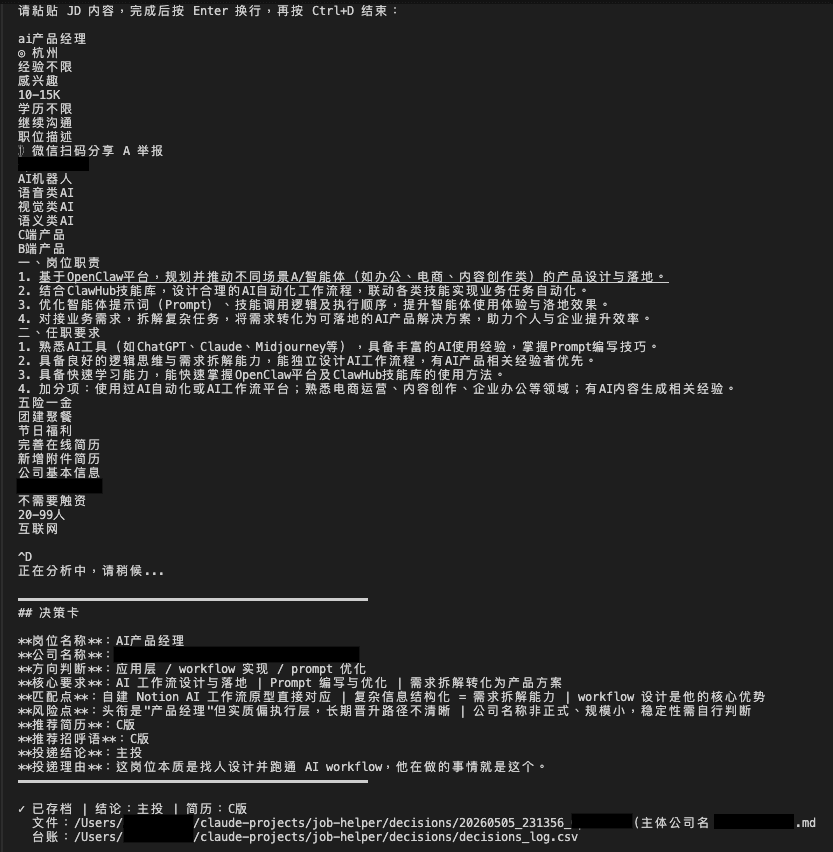
jd 命令行工具完整链路展示——从 JD 输入、AI 解析、决策卡输出到本地双轨留存。 / jd CLI tool full pipeline: from JD input through AI parsing to decision card output and local dual-track logging.| 日期 | 岗位 | 风险点 | 结论 | 投递理由 |
|---|---|---|---|---|
| 05-02 | AI 产品经理 建筑方向 | 模型训练与优化有技术门槛 | 可冲 | 建筑背景是这岗少有的硬门槛,你天然过了,值得试一试。 |
| 05-03 | AI 产品经理 | Python / 系统对接有权重 | 可冲 | 叫“产品经理”但做的是 workflow 落地,你的原型经验直接说得上话,值得试。 |
| 05-03 | 产品经理 全生命周期 | 明确招 2026 届应届生 | 暂不主投 | 专招应届生且偏工程背景,两道硬门槛同时卡住,这一轮先跳过。 |
| 05-03 | 女装 AI 产品专家 | JSON 配置 / 系统集成有门槛 | 可冲 | 流程梳理和协同落地是你的真实优势,但技术实施那半块是真门槛,冲了再说。 |
| 05-03 | AI 产品策划 | 要求独立主导产品全流程 | 暂不主投 | 名字像,但这是要你独立做产品的 PM 岗,不是你的方向。 |
| 05-04 | AI 产品经理 | PM 角色要求完整产品能力 | 可冲 | 门槛不高、方向对味,别把自己包装成纯 PM,突出“协同推进+落地”更稳。 |
| 05-04 | AI 产品经理 | 平台依赖性强,需快速学习平台专有体系 | 主投 | 工作流设计+需求拆解+AI 落地,几乎全命中你的核心能力,冲它。 |
| 05-04 | AI 产品运营 校招 | 实质是社媒内容+增长 | 暂不主投 | 典型同名异向,核心工作是发内容和拉新留存,不是你想走的那条路。 |
| 05-04 | 大模型 AI 产品运营 | 实质是语料标注与算法支持 | 暂不主投 | title 写的是产品运营,做的是算法语料标注,偏差太大,别被名字骗了。 |
| 05-04 | AI 产品运营 | 实质是投放(SEM/KOL)运营 | 暂不主投 | 名字叫产品运营,做的是投广告写 brief,绕路了。 |
05-02
模型训练与优化有技术门槛
建筑背景是这岗少有的硬门槛,你天然过了,值得试一试。
05-03
Python / 系统对接有权重
叫“产品经理”但做的是 workflow 落地,你的原型经验直接说得上话,值得试。
05-03
明确招 2026 届应届生
专招应届生且偏工程背景,两道硬门槛同时卡住,这一轮先跳过。
05-03
JSON 配置 / 系统集成有门槛
流程梳理和协同落地是你的真实优势,但技术实施那半块是真门槛,冲了再说。
05-03
要求独立主导产品全流程
名字像,但这是要你独立做产品的 PM 岗,不是你的方向。
05-04
PM 角色要求完整产品能力
门槛不高、方向对味,别把自己包装成纯 PM,突出“协同推进+落地”更稳。
05-04
平台依赖性强,需快速学习平台专有体系
工作流设计+需求拆解+AI 落地,几乎全命中你的核心能力,冲它。
05-04
实质是社媒内容+增长
典型同名异向,核心工作是发内容和拉新留存,不是你想走的那条路。
05-04
实质是语料标注与算法支持
title 写的是产品运营,做的是算法语料标注,偏差太大,别被名字骗了。
05-04
实质是投放(SEM/KOL)运营
名字叫产品运营,做的是投广告写 brief,绕路了。
decisions_log.csv 共 108 条记录,覆盖主投、可冲、暂不主投三类结论的代表案例。 / Excerpt of 10 — full log: 108 entries in decisions_log.csv, spanning all three verdict types: primary, stretch, and skip.06 | 方法论验证 Validation
当前数据 / Current Data(验证中 Validating)
- 实际投递数:约 30–50 个(按"主投"和"可冲"档投递)
- 回复率:单独追踪——取决于市场反馈,不计入本工具的判断效率验证
What this section validates is decision efficiency, not market response — reply rate and interview conversion depend on the market rather than the tool, and are tracked separately.
- 岗位判断总数
- 108
- 全链路累计耗时
- 3h41m
- 效率提升倍数
- 10×
初步观察 / Initial Observations
决策卡的"方向判断"在多次实测中有效识别了 title 与实际方向的偏差(例:title 标注"AI 产品经理",决策卡识别为"偏技术实验向,含 ComfyUI / 模型训练要求")。
The "direction" field reliably caught title-vs-reality gaps in repeated tests.
简历版本推荐与个人事后判断的一致性较高,目前未发现明显错配。
Resume version recommendations have shown high consistency with retrospective judgment; no significant mismatch observed yet.
部分极端案例(要求 5 年经验 / 要求 985 名校 / 要求纯算法背景)会被决策卡明确标为"暂不主攻",与人工判断一致——说明判断模板对"硬门槛"识别可靠。
Edge cases (5+ years required / Tier-1 universities only / pure algorithm background) are reliably flagged as "do not pursue" — confirming the template's reliability on hard filters.
07 | 反思与边界 Reflection & Boundary
一个工具的边界和取舍,和它解决的事一样重要。
A tool's boundaries and trade-offs matter as much as what it solves.
它解决的事 / What It Does
把"识别同名异向、匹配简历版本、归类风险信号"这类结构化但重复的决策成本降到趋近于零;把使用者的精力从"读 100 份 JD"里释放出来,转向更值得投入的事——研究方向、打磨作品、补行业知识。
Drives the cost of structured-yet-repetitive decisions (catching title mismatches, matching resume versions, classifying risk signals) toward zero — and frees the user's energy from "read 100 JDs" toward work that deserves it: studying directions, refining the portfolio, building domain knowledge.
它没有解决的事 / What It Does Not Solve
- 投递反馈稀疏、周期长这一结构性现实(属于平台展示机制 + 招聘市场结构问题,不是工具能解决的)
- 回复率本身(取决于市场反馈,不是工具能左右的)
- 面试转化率与 offer 质量(更长的反馈周期)
The structural reality that application feedback is slow and sparse (a platform-display + hiring-market issue, not a tooling one), reply rate itself (market-dependent, not the tool's output), interview conversion and offer quality (longer feedback loop).
关于"半自动"的取舍 / On the "Semi-automated" Trade-off
工具刻意保留了"由使用者手动点击立即沟通 / 投递"这一步。
The tool deliberately keeps "click to chat / submit application" as a manual step performed by the user.
原因有三:
- 自动投递触发平台风控(路径 1 已验证)
- 自动投递让使用者失去对每个岗位的最后一次审视机会
- 求职是高风险决策,保留人类最终决策权比追求"全自动"更重要
The reasons are threefold: auto-apply triggers platform risk-control (verified in Path 1); auto-apply removes the user's last review checkpoint per posting; job hunting is a high-stakes decision — preserving the human's final say matters more than chasing "fully automated."
这是工具的边界,也是它在 ops / 平台支持 / 客户成功这类工作里应有的姿态——半自动不是"功能不完整",是对人类判断权的有意保留。
This is the tool's boundary — and the posture it should maintain in ops / platform support / customer success contexts: "Semi-automated" is not "incomplete automation" — it is a deliberate preservation of human judgment.